There is a moment, rare and terrifying, when the veil of comfortable illusion lifts and the human
being sees clearly for the first time. In that moment, the world does not appear brighter or more
beautiful. It appears as what it has always been: a carefully constructed prison, its bars painted
to look like virtues, its walls papered with noble sentiments, its guards disguised as saviors.
Friedrich Nietzsche understood this moment intimately. He called it the "revaluation of all values",
the shattering recognition that what we have been taught to call good is, in fact, the triumph of
weakness over strength, of resentment over nobility, of life-denial over life-affirmation.
Nietzsche's diagnosis of the "slave revolt in morality" is not merely a historical observation but a
living reality, operational in the present moment with greater intensity than in his own time. The
priests who engineered this inversion, the architects of a value system that glorifies servitude,
humility, and suffering as virtues, have not disappeared. They have merely changed their robes. And
the source of this inversion, whether understood psychologically or as the influence of external
forces of control, points toward a cosmic conspiracy against human potential.
The Birth of the Slave Revolt
Nietzsche's genealogical method, developed most fully in On the Genealogy of Morals, traces the
origins of modern morality to what he called the "slave revolt." Initially, human morality was the
morality of the strong, what Nietzsche termed "master morality." The noble, the warrior-aristocrats,
called themselves "good" and viewed those beneath them as merely "bad", a descriptive term without
moral condemnation. Strength, health, wealth, conquest, and the free discharge of power were
celebrated as natural expressions of vitality.
The slave revolt inverted this entire value system. The weak, unable to compete physically, turned
their impotence into a weapon of psychological warfare. They redefined goodness as the absence of
strength: humility, obedience, meekness, and compassion for the suffering became virtues. Meanwhile,
the qualities of the strong, aggression, pride, ambition, and self-affirmation were recast as
"evil." The slave morality triumphed not through conquest but through redefinition, poisoning the
wells of human vitality from within.
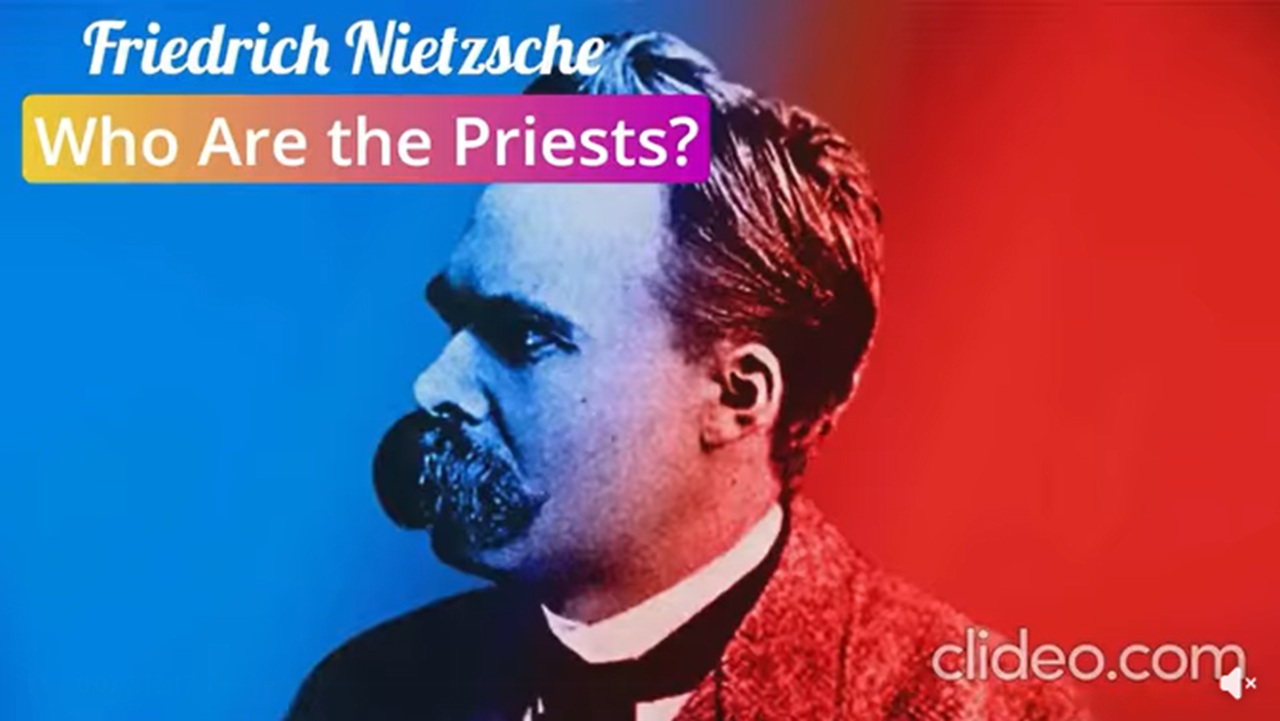
Who Are the Priests?
The architects of this revolution were the priests. Nietzsche describes them as a specific
psychological type: physically weak, intellectually intense, deeply brooding, and consumed by hate.
They are the "great haters" of history, not in the sense of crude vengeance, but in the refined,
spiritualized hatred that transforms weakness into a moral victory over strength.
The priest's genius was to invent the concept of "free will" specifically to trap the strong. He
declared that the powerful were not acting out of natural instinct but out of evil choice, and
therefore deserved punishment. Simultaneously, he taught the weak that their suffering was not a
sign of failure but a test of their virtue, a sacred burden that would be rewarded in an afterlife.
In this single stroke, the priest achieved the impossible: he made strength sinful and suffering
holy.
"The slave's morality is born of resentment: it says 'No' to what is outside it, what is different,
what is not itself." ~ Nietzsche
The priest did not simply impose these values through force. He internalized them in the human
psyche, transforming the instinct of self-preservation into guilt, the drive for power into shame,
and the natural desire for conquest into sin. This internalization was the priest's greatest
triumph. He did not need to guard the prison because the prisoners had learned to guard themselves.
The Source of the Seed
Nietzsche's genius lies in his diagnosis of the symptoms. He traces the slave revolt to the
psychological mechanism of resentment - a deep, lasting feeling of anger and bitterness, the
festering, hatred of the weak against the strong. But a question lingers at the edge of his
analysis: why did the priestly type succeed so completely? Why did humanity, across continents and
cultures, adopt a value system that negates its own vitality?
The answer may lie beyond psychology, in the realm of external forces of control. Whether understood
as the manipulation of human consciousness by unseen intelligence, the influence of cosmic forces
that seek to keep humanity docile, the inversion of values appears too systematic, too pervasive,
and too resilient to be purely accidental.
Consider the pattern: across civilizations, the same inversion emerges. Strength is demonized.
Weakness is glorified. The individual is taught to distrust his own instincts and look outward for
moral guidance. The body is treated as suspect, the intellect as dangerous, and the will as
something to be broken. This uniformity suggests design rather than accident, a deliberate program
to condition human beings into accepting servitude as normal and even beneficial.
The Priests as Unaware Hosts
If external forces of control exist, they do not need to micromanage every human mind. They need
only to plant a seed in the most susceptible soil, the priestly type. The priests, believing they
are receiving divine revelation or philosophical insight, become unaware hosts of a memetic virus
that spreads through culture, religion, law, and education. They are not evil masterminds; they are
controlled opposition, genuinely believing in their own righteousness while serving an agenda they
do not fully comprehend.
The priest is the first human host of an ideological parasite. His resentment is not purely
self-generated; it is amplified, focused, and weaponized by forces that understand human psychology
better than humans understand themselves. The priest thinks he is saving souls; in reality, he is
programming them for servitude.
"The paradigm of science is that creation is all, and the creator is nothing. Religion says the
creator is all, and the creation is nothing. These two extremes are the bars of a prison cell."
This observation captures the essence of the control system: humanity is trapped between false
differences between two completely opposite ideas, prevented from perceiving its own inherent power
and sovereignty. The priests, in their various guises, maintain these bars.
The New Robes
The priests of Nietzsche's time wore clerical robes and spoke of God. The priests of our time wear
lab coats, academic gowns, activist banners, and the uniforms of bureaucrats. Their theology is
secular, but their function is identical: to weaken humanity, to fragment its consciousness, to
teach it to distrust its own strength, and to condition it for servitude.
Consider the contemporary obsession with safety, particularly the safety of children. The modern
priest preaches that any risk, any discomfort, any exposure to natural consequence is trauma that
must be eliminated. Children are wrapped in protective foam, shielded from skinned knees, and raised
in an environment that removes every obstacle from their path.
Nietzsche knew that strength is forged in overcoming resistance, not in its absence. To remove all
challenge is not to protect but to domesticate, to breed a creature that cannot fight, cannot
endure, and cannot think independently. The helmeted, anxious child is being conditioned for a life
of dependence, always looking outward for permission, protection, and guidance.
But what if we remove everything that might kill, hurt, or challenge? Then nothing makes you
stronger. You simply remain weak. This is the priestly project: manufacturing permanent
helplessness.
The modern priest of the digital age has perfected the art of mental fragmentation. Through
algorithmic content, infinite scroll, and constant notifications, human attention has been shattered
into seconds. The average person cannot sustain focus for more than a few seconds without external
stimulation.
The priests of old wanted you to stop thinking so you would obey God. The priests of today want you
to stop thinking so you would obey the algorithm. The result is the same: a mind that cannot sustain
reason, cannot resist manipulation, and cannot conceive of greatness. The "last man" described by
Nietzsche, blinking, comfort-seeking, incapable of ambition, has become the average human being.
This is not an accident. It is a designed state, a priesthood of engineers, psychologists, and data
scientists who have perfected the art of cognitive disintegration.
The most visible modern priests are those who preach against hierarchy, strength, and traditional
values while obsessively measuring themselves against those they condemn. Consider a woman who
rejects conventional standards of beauty that cannot stop talking about the alpha male, the
patriarchy, or the oppressive structures that supposedly victimize her.
This is the pure essence of priestly resentment. Unable to compete in traditional hierarchies, the
modern priest declares all hierarchies to be oppressive. Unable to attract or achieve, she frames
her rejection as liberation. Unable to be strong, she preaches that strength itself is toxic.
But note the obsession: she defines herself entirely in opposition to what she condemns. Her every
word confirms the existence of the standard she claims to reject. She is the living embodiment of
Nietzsche's diagnosis, the slave who has made a virtue of her slavery and seeks to drag everyone
else into the same condition.
The Architecture of Amnesia
The priests of all ages share a common goal: to blind humanity to its own nature. The ancient
priests taught that humans are born in sin, inherently corrupt, and dependent on external grace for
salvation. The modern priests teach that humans are fragile, traumatized, and dependent on
institutions for safety and meaning. In both cases, the message is the same: You are not enough. You
cannot trust yourself. You need us to tell you who you are and what to do.
This blinding operates through multiple mechanisms:
Guilt: The internalization of shame that makes humans distrust their own instincts and desires.
Dependence: The systematic removal of self-sufficiency through institutional control.
Fragmentation: The destruction of sustained attention and coherent identity.
False Dichotomies: The presentation of mutually exclusive choices that prevent humans from
perceiving their own inherent power.
The Path to Destruction
Nietzsche feared that the triumph of slave morality lead to nihilism, the point at which humanity no
longer believes in anything because it has devalued all that is life-affirming.
The modern priests have accelerated this process. A blinded humanity cannot see its own prison. A
weakened man cannot resist its own subjugation. A fragmented man cannot organize for liberation. The
path from blindness to destruction is short and well-paved.
The truth, that humanity has been systematically conditioned to accept servitude, is terrible
precisely because most people cannot bear to see it. They prefer the comfortable lie: that they are
free, that their suffering is meaningful, that their obedience is virtue.
Seeing Clearly
Observation is itself an act of resistance because it refuses to participate in the collective
trance. To see the priests for what they are, in their clerical robes, their lab coats, their
activist banners, is to begin the process of liberation.
But Nietzsche's philosophy is not passive. He calls for the transvaluation of all values, the active
creation of new values by those who see clearly. Observation is the first step. The second step is
living differently: refusing the helmet, refusing the scroll, refusing the resentment, and affirming
your own strength, creativity, and will to power.
What Do You Become?
The priests want you to ask, "What should I do?" because asking that question assumes that someone
else has the answer. The liberated human asks instead, "What do I become?" The answer is not given
by any authority; it is created through your own life, your own choices, your own affirmation of
what is noble, strong, and life-affirming.
This is the opposite of the priestly command. The priests tell you to become what they need you to
be: docile, weak, dependent, and grateful for your chains. Nietzsche tells you to become what you
already are, beneath the layers of guilt, shame, and programming: a sovereign individual capable of
creating your own values and affirming your own existence.
The Terrible Truth
The truth is terrible because it reveals the extent of the deception. The priests, ancient and
modern, religious and secular, have constructed a moral architecture designed to keep humanity weak,
divided, and blind. They have inverted the natural order so that strength is called evil and
weakness is called good. They have taught humanity to accept servitude, humility, and suffering as
normal and even beneficial.
But the truth, however terrible, is also liberating. Once you see the bars of the cage, you can no
longer pretend they are not there. Once you recognize the priests, you can no longer obey them
blindly. Once you understand the inversion, you can begin the work of revaluation, not through
violence or coercion, but through the quiet, radical act of living in accordance with your own
nature.
The priests will continue their work. They will wrap children in foam, fragment attention, preach
resentment, and blind the herd. But you will see. And seeing, you will remember who you truly are:
not a servant, not a sinner, not a victim, but a sovereign being capable of creating meaning and
affirming life.