
We Are Our Own Prison
Introduction: The Regret No Dying Person Ever Spoke
Australian nurse Bronnie Ware spent eight years working in palliative care, sitting with patients who were dying. She recorded the most common regrets they expressed at the end of their lives-observations later collected in The Top Five Regrets of the Dying. At the top of the list: "I wish I'd had the courage to live a life true to myself, not the life others expected of me." Then: "I wish I hadn't worked so hard." Then: "I wish I'd had the courage to express my feelings," "I wish I had stayed in touch with my friends," and "I wish that I had let myself be happier."
These regrets share a common underlying structure: they lived inside an identity that was not their own, and they died without ever stepping out of it. They lived for other people's expectations, for the treadmill of work, for the maintenance of surface peace by suppressing what was actually true. They spent a lifetime playing a role, and only at the end did they realize the role was never them.
But notice what is absent from every regret Ware recorded. Not one person said: "I wish I had found out who I actually am." No one said: "I wish I had seen through the thing that made me live this way." They saw the symptoms-too much work, too few friends, unexpressed feelings-but they never saw the cause. They died inside the prison, complaining only that the walls were the wrong color.
And if all you take from that list is "spend more time with friends, express your feelings, work less," you are only redecorating the prison cell. You will come back next time, because the one doing the redecorating is the same one who has never examined - the "you" shaped by expectation, driven by fear, governed by habit.
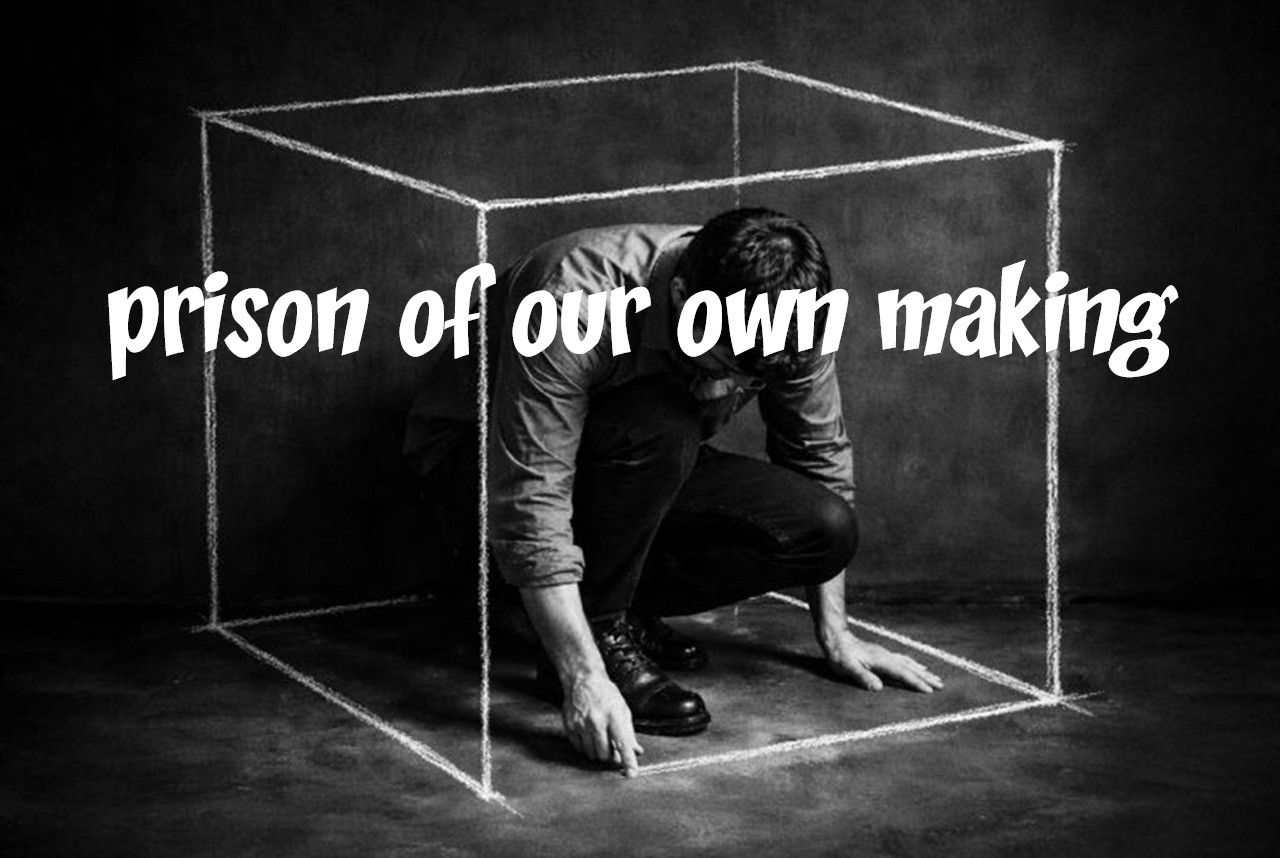
We become our own prison.
What We Are Doing to Ourselves?
When we say "we are our own prison," it is not a poetic metaphor. It means: the psychological structures that keep us stuck-the automatic reactions, the unexamined assumptions, the patterns that return us to the same pain over and over-they are not somewhere else. They are us. More precisely, they are the part of us we mistake for ourselves.
This mistaken identity is based on few recognizable psychological imitations such as: imitation, mechanical repetitions and wrong authority.
We cannot produce anything genuinely new, so we manufacture copies. Every impulse toward real knowing has a counterfeit version waiting for it. Most of what passes for "growth" and "spiritual seeking" falls into this category: it scratches the itch but never breaks the skin. That version feels like awakening, but it changes nothing except the furniture.
We believe we are making choices, but we are executing programs. Emotional cycles, the pull of habit, judgments that fire before reflection even engages-these are not "our personality." These are what we use as a substitute for ourselves. The story you tell yourself about why you are the way you are, the assumption about who you are that you have never questioned-that is the architecture of the prison. Not guards with iron bars. Guards with beliefs.
We believe these things are "the way we are," so we defend and obey them. Every time you get close to something real, something pulls you back to the ordinary-that is not your weakness, that is your understanding operating. Nothing needs to block you from outside. It has convinced you to block yourself. The bars of the cage are made of your own unexamined thoughts.
The Psychological Structure of the Prison
These things are not abstract. They can be recognized, if you are willing to look. Here are psychological threads, each one a distorted quality and instrument of captivity.
Control disguised as strength - The impulse to dominate others, to win the conversation, to prove you are stronger. It feels like power, but its root is lack. Real strength needs no audience.
Compliance disguised as goodness - Doing "the right thing" without understanding why. People-pleasing, going along with the crowd, mistaking obedience for virtue. You follow the rules, but you never asked who wrote them.
Judgment disguised as seeing - the inner voice that automatically evaluates everything-including yourself. It scans for flaws, it categorizes, it passes sentence. You think you are "seeing and knowing the facts," but you are only running assuming programs based on your biases.
Craving disguised as passion - The hunger that is never filled. For food, for validation, for stimulation, for more. It looks like you are pursuing something, but it is only fleeing a void you will not face.
Distraction disguised as pleasure - The endless scroll, the one-more-episode, the constant reaching for something comfortable to avoid sitting with what is actually here. The sweetness keeps you on the surface.
Confusion disguised as insight - You believe your thoughts about reality are truth itself. You mistake the story for the thing. You do not know what is true and what you were told.
Urgency disguised as importance, something that has meaning - Never enough time. Always rushing. The busyness keeps you from ever stopping long enough to look at what is actually happening.
When you put these together, you are not looking at a list of sins. You are looking at a diagnostic manual describing how your consciousness cuts off its source continuously producing its own captivity through mechanisms it cannot see.
Recognition: Not Labeling, But Seeing Through
There is a crucial distinction that many people misunderstand. When you hear "recognize the prison," the first instinct may be to treat it as a debugging task: catch the thought, label it, move on. That is something else than to what is being pointed at here.
You are not catching something foreign. You are seeing through something you have been mistaking for yourself.
It is not that you encounter the prison. It is that you are already inside it. Recognition is not discovering some alien intruder; it is seeing through a structure you have taken to be yourself. The recognition is not "I see the prison." The recognition is: "I see that the thing that was identifying with this pattern was never actually me."
That is an entirely different move.
Most spiritual traditions that deal with psychological limitation give you a method for change: meditate, practice virtue, gradually purify. But the move here is not to change the prison's structure. It is to withdraw identity from it.
You do not need to fix the patterns. You need to see that what was being defined by the patterns was never you.
Attention is the Key
This is not a ten-step process. It is a perceptual orientation of self-observation that moves your attention in two directions simultaneously.
First direction: witness the emotional state without merging with it. Not suppression, not analysis-just the quality of attention that can hold a psychological state without becoming it. Anger arrives; you see it. Judgment arrives; you see it. The seeing itself is not anger, is not judgment.
Trace the emotions to its function. Do not ask "what am I feeling," ask "what is this state trying to accomplish." Fear of judgment usually is trying to maintain social position. Compulsive craving is trying to counter lack. Time pressure is trying to produce a sense of control. When you see the function clearly, you see the mechanism. When you see the mechanism, you are already slightly outside it.
Second direction: locate the observer that what there prior the emotion. Not better, not more spiritual. What was already there before this prison pattern activated. The awareness that exists before any specific state arises. That is not a state you achieve; it is a ground you recognize as always having been there.
The prison's structure you made around that ground cannot withstand that kind of attention. Prison was built for a consciousness that never turns to look at its own foundation. When you truly look-not analyze, but look with inner stillness-something loosens. Not dramatically, not in a way that would make good television. Just loosens, like a hand grip that was not fully aware of itself relaxing.
What You Can Actually Do
Stop treating your psychological patterns as personal failures. Start treating them as recognizable structures of your own prison.
This gives you the map, the distorted qualities, the attributes of fear and desire and judgment and craving. But the purpose of the map is never to make you feel more sophisticated about your suffering. The purpose is to make suffering visible. And visibility is the beginning of freedom.
The next time you feel something you cannot name take hold of you-the compulsive loop, the reactive pattern, the psychological weather that arrived uninvited-do not merge with it. Look at it. Ask what it is doing, and what it needs from you to sustain itself. Then look at the thing that is looking.
That is the most essential form. No ritual required, no institution necessary, no intermediary between you and the recognition.
Stop being managed by what you have not yet named. Start recognizing what is actually operating.
You were not put here to be ruled by structures you were never shown. You were put here to see through them.
The dying never voiced that regret because no one ever gave them this knowledge. You have been given it.
Do not let this be just information. Let it be a lens through which you see your life.